Composing for Dinosauria: Score, History, and Collaboration with David Armsby
Back in 2022 I received an email from David Armsby. He was looking for music for what would become the Dinosauria series, and the moment I saw his work I knew I wanted to be part of that world.
David’s ability to weave story, animation, editing, and sound into a cohesive emotional experience is something I’d describe as pure mastery. His films have an extraordinary level of detail — things you miss on a first watch, things that only reveal themselves when you return to them. As a composer, I get to watch a film again and again, and that level of intentionality in his work constantly shaped what the music needed to be.
From David’s studio in Scotland to mine in Argentina, the Dinosauria collaboration became a bridge not just across continents but between two storytellers. What follows is the story of how the music for two of those films was made.
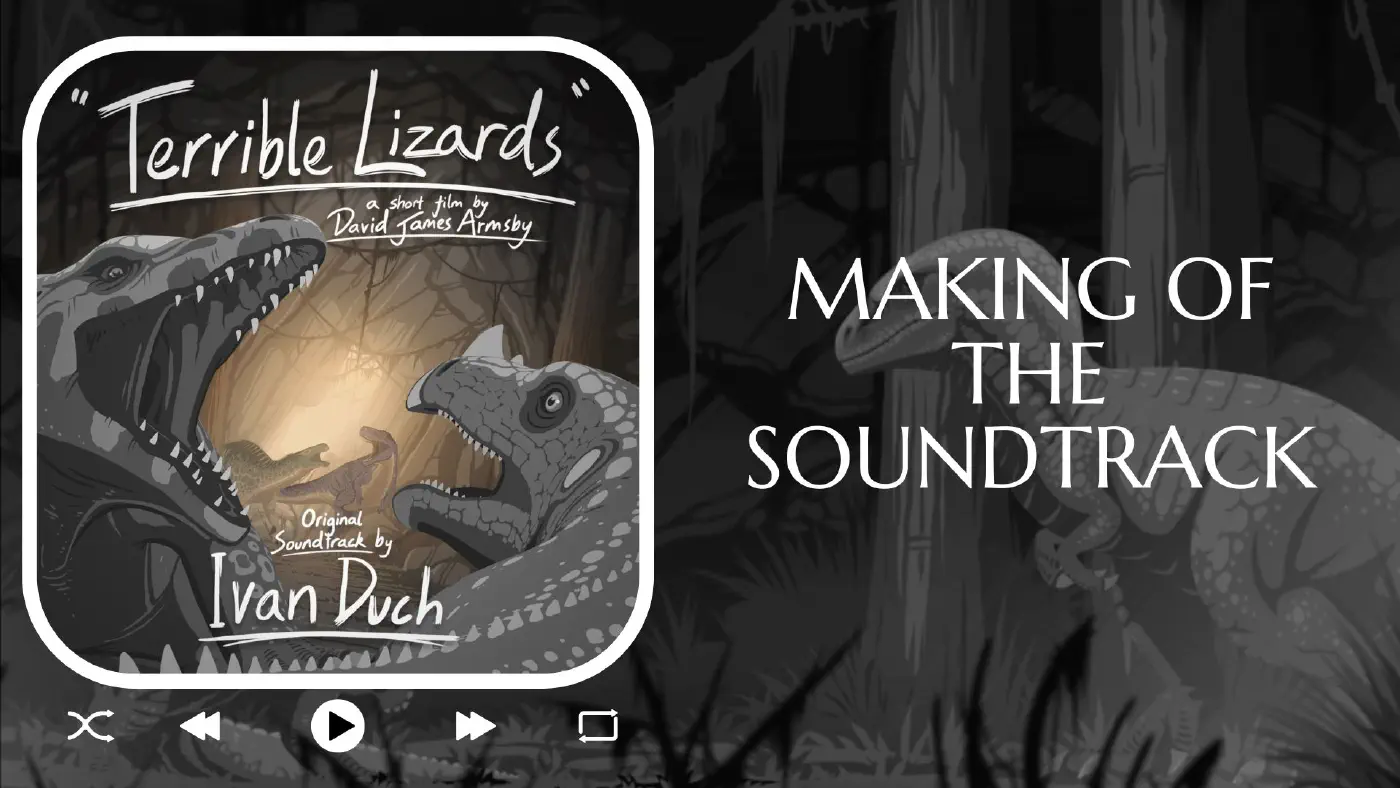
Terrible Lizards: A Score That Travels Through Time
Dinosauria: Terrible Lizards is a love letter to both cinema and our evolving perception of dinosaurs — structured as four distinct eras, each with its own visual language. From the moment I understood what David had built, I knew the music had to follow the same logic: not one score, but four, each one speaking the musical language of its time.
1842 — Mystery and the Romantic Orchestra
The first piece I had to write was for 1842, when dinosaurs were still creatures of myth — imagined as terrifying, towering monsters, long before they appeared on any screen. I wanted the music to sound like it came from the Romantic period but feel mysterious, almost primal.
I went back and forth trying to find the right sound. In the end I leaned into a relentless pounding pulse carried by the orchestra — something that felt ancient and inevitable. The theme appears here for the first time, connected to the Iguanodon that opens the film, but stated minimally, barely suggested. It was a seed that would grow through every era that followed.
1933 — Max Steiner, King Kong, and a Mono Mix
When I saw how David had animated the 1933 segment, something clicked immediately. It took me back to my childhood — to my grandfather’s worn-out VHS copy of the original King Kong, afternoons watching in black and white. That memory came flooding back, and I knew I had to give it everything I had.
Musically I turned to Max Steiner, one of the founding fathers of film scoring. His work on King Kong was a major influence, but somehow my love for the 1941 Superman cartoon crept in too — those heroic brass lines, that rhythm, that larger-than-life feel. That era has a very particular compositional vocabulary and I had to research it deeply to actually get the hang of it, not just approximate it.
Two cellists and a trumpet player recorded this cue, giving the orchestra that vibrant, classic energy. But it wasn’t just the instruments — even the mix had to follow the era. I started in mono, just like a recording from the 1930s, and slowly opened it up into a stylised stereo image as David’s transitions led into each successive era. The technical choices had to tell the same story as the compositional ones.
1999 — Jurassic Park and the Grand Heroic Theme
If 1933 was the beginning of dinosaurs on screen, then the 1990s crowned them as legends. When I was around nine years old I won tickets for my entire family to see Jurassic Park at the cinema. That experience burned into my memory — and David’s depiction of that era hit me right in the heart.
The specific tone of that era was awe: science meets cinema, dinosaurs presented as sentient animals for the first time. I made the theme as grand and heroic as I could — maybe even a little over the top, but that was right. Big brass lines, soaring strings. I wanted the score to feel like a documentary and an adventure film at the same time. A trumpet player and cellist recorded this cue, and the trumpet especially pushed the music into that bold, epic space.
2025 — Synths, Singers, and the Emotional Climax
For the final chapter I wanted the music to reach a real climax — something emotional, portraying both our love for cinema and our perception of dinosaurs as full sentient beings deserving of the same respect we’d give any living creature.
Synths entered the score for the first time here. And I was lucky to work with two remarkable singers who gave this segment a sense of intimacy and scale that the orchestra alone couldn’t reach. Their voices found the emotional peak the ending needed.
My daughter, who was eight at the time, helped me choose the singers. My wife and daughter both listened as the music was taking shape and gave me feedback that more than once led to a better decision than I’d have made alone. That felt completely right for a project whose whole spirit was about collaboration.
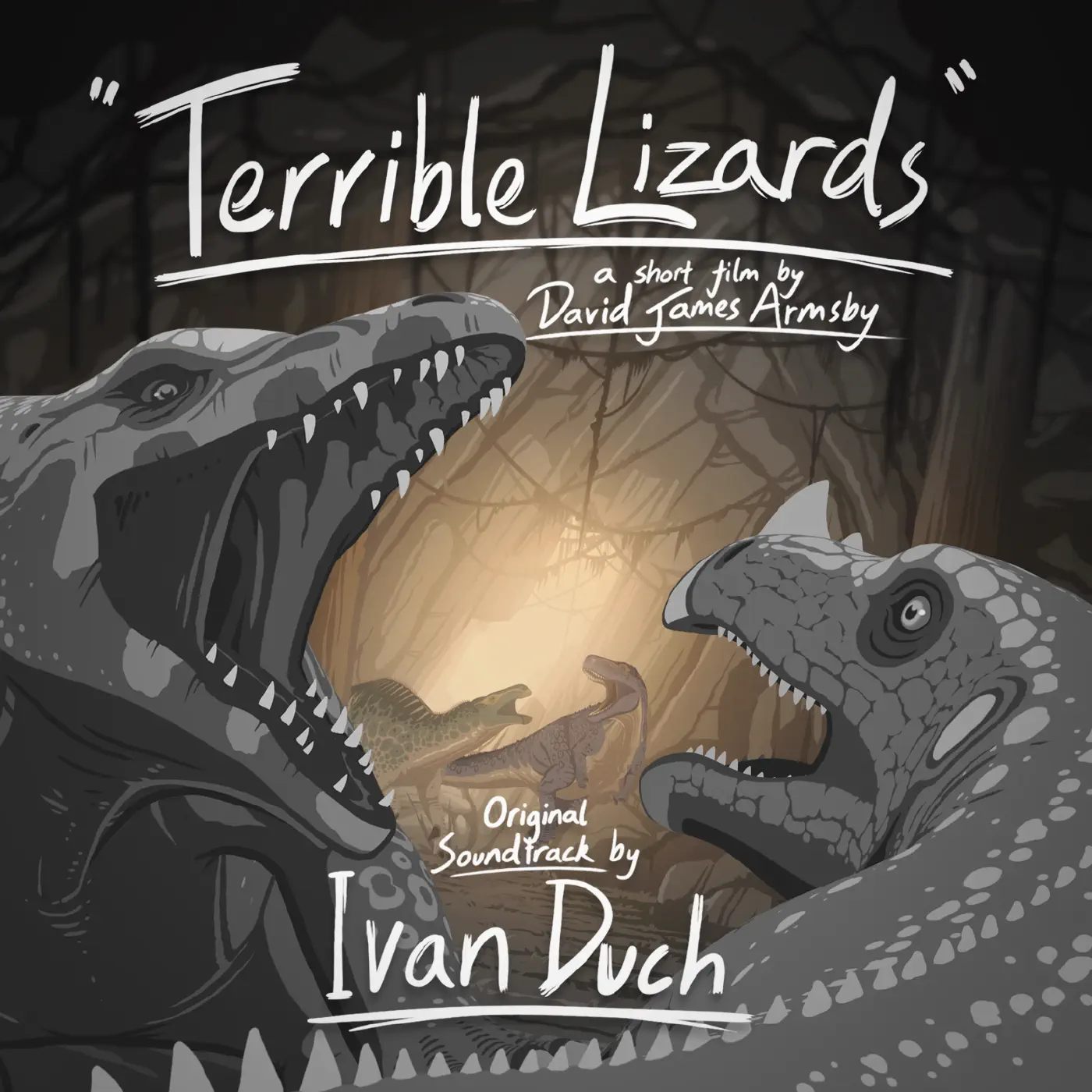
Hunted by Moonlight: Collaboration as Concept
Dinosauria: Hunted by Moonlight is a different kind of film from Terrible Lizards — quieter, stranger, with the soul of a dark fairy tale. When David sent it to me, I knew immediately this one was different. There was something between beauty and terror in it, and David described the old Brothers Grimm stories where innocence meets the wild and nature itself becomes both magical and monstrous.
We spoke at length about tone. I remember sending him earlier works of mine and he said it needed to feel more playful, more childlike. He was right. That single comment changed everything.
The Walk, the Cello, and the Concept
I decided the cello would be at the heart of this story during a walk through the forest near my home. I was looking for inspiration, and something about the surroundings made it feel inevitable — the cello as the voice of the forest, of the night, of the dark tale itself. It had to carry fear, beauty, and raw nature all at once.
But the film’s deeper theme — creatures coming together to face the cruelty of nature, the ending that becomes a story about collaboration — shaped the music at a level beyond instrumentation. I was living in an age where one person can produce music almost entirely alone, surrounded by virtual instruments and screens. I’d been doing exactly that for years. Hunted by Moonlight called me back to something different.
Daniel Chouinard and the Living Cello
When Daniel came in, we spent a great deal of time talking about what is truly idiomatic to the cello — what makes it breathe, what makes it resonate in ways that no sample library can replicate. He shared techniques and timbres I’d never heard before. His experience transformed the entire score.
The techniques we built the score around — triplets, ponticello, glissando, arpeggios played almost like fingerstyle guitar — aren’t melodic in a traditional sense. They imply harmony without stating it, creating an atmosphere that can feel frantic, ambient, mysterious, or horrifying depending on context. Daniel pointed out that these techniques really belong to solo string writing, not ensemble work, and that they’re precisely the things that still separate a human player from any MIDI program, no matter how sophisticated.
For many of the most atmospheric moments, I actually asked Daniel to improvise — aleatoric techniques where I said: go crazy, whatever comes to mind. Those improvised gestures are scattered throughout the soundtrack, and some of them became the musical signature for specific characters and moments.
I also rediscovered the guitar during this project. Most of the ideas began away from the computer, on paper with the guitar in my hands. I even tuned it like a cello for much of the writing, to experiment with ideas before sending parts to Daniel. That physical contact — fingers on strings, the vibration of wood and air — reminded me what I’d been missing. It was the opposite of working on a screen. Alive, immediate, imperfect.
The Other Musicians
Dorothy Takev, from Bulgaria, brought her ethereal voice to become the spirit of the forest in the score. Matias Tozzola, from Argentina, played the seven-string guitar, creating horror-like textures that I didn’t know were possible. Bruno Migliari, from Brazil, played double bass, giving the soundtrack its gravity and heartbeat.
Every recording session felt like an exploration. Each musician brought their world — their stories, their instincts, their humanity — to how they performed. That’s what makes music alive. And in an age where it’s becoming easier to isolate, to create without ever hearing another person’s breath, I think that kind of collaboration is a small act of resistance.
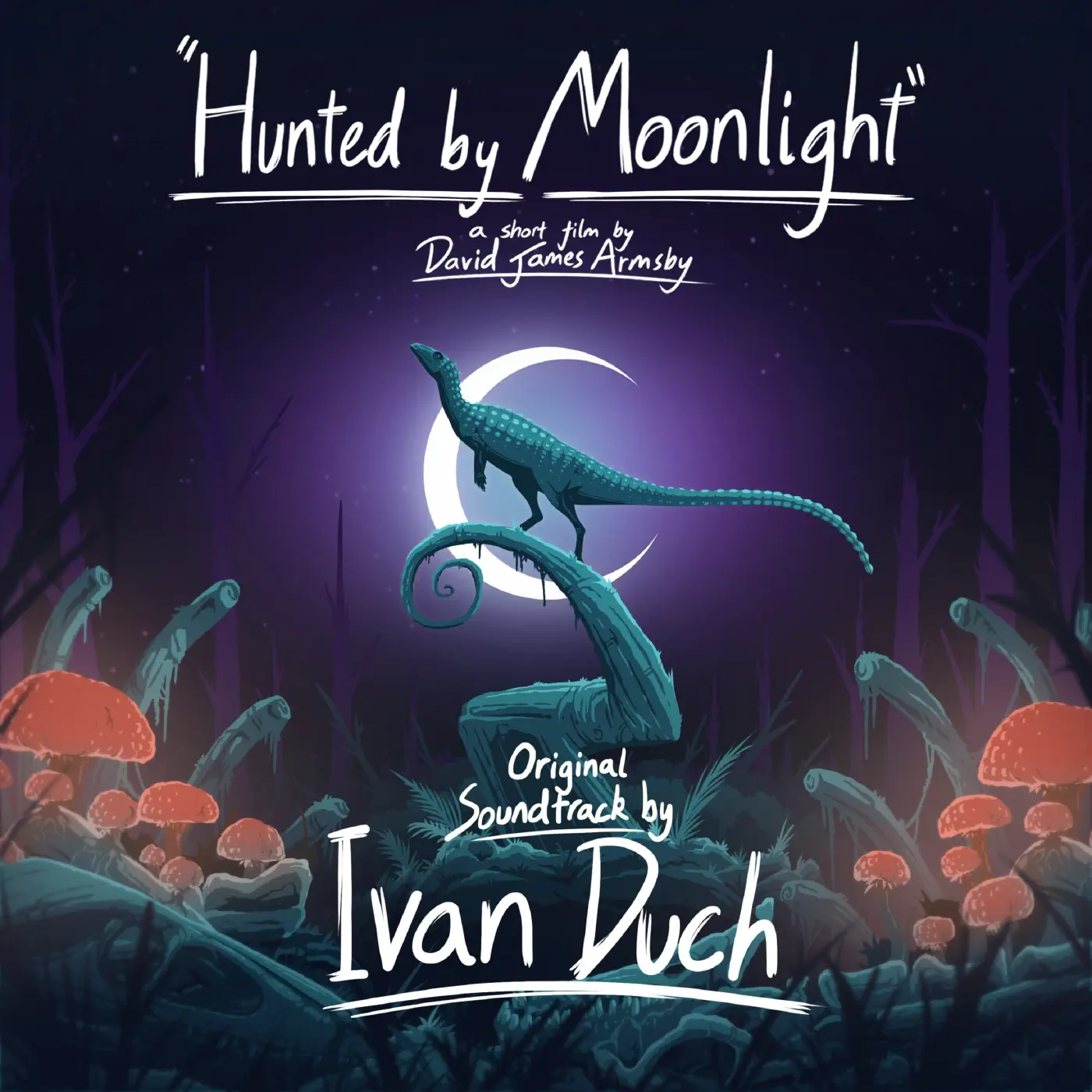
What Connects These Two Films
Working with David across both of these projects taught me something I carry into every project now: art grows from conversation. From many hands, many voices, shared curiosity between fellow human beings.
The music for both films is shaped by that principle as much as by any compositional decision I made. The score for Terrible Lizards draws on a century of film music history because I was in conversation with that history. The score for Hunted by Moonlight draws on the specific voices, techniques, and humanity of the musicians who recorded it.
That’s what musical worldbuilding means to me in its deepest form — not just building a world through music, but building music through the world around you.
You can hear the Dinosauria soundtracks on their respective album pages, and read more about this approach on the worldbuilding music hub.
If this kind of compositional thinking interests you — working with live musicians, researching historical sound worlds, building a score around a central concept — it’s something I work on directly in private mentoring sessions. It starts with a short call to see if we’re a fit.