Composing the Svilland Soundtrack: Scoring a Norse Mythology Setting for 5E
Some commissions ask you to score a story. Svilland asked me to score a mythology.
Dream Realm Storytellers — an independent studio out of Turkey — had built one of the most uncompromising Norse settings in the 5E space: a low-fantasy, genuinely grim take on Norse myth, where wizards are replaced by Runewalkers drawing power from the runes Odin gives his people, and where the valour and brutality of the old sagas are the texture of everyday play. Their Freyja’s Tears campaign for the setting raised over £189,000 from nearly 3,900 backers. They asked me to write the music and ambiance that would sit under it at the table.
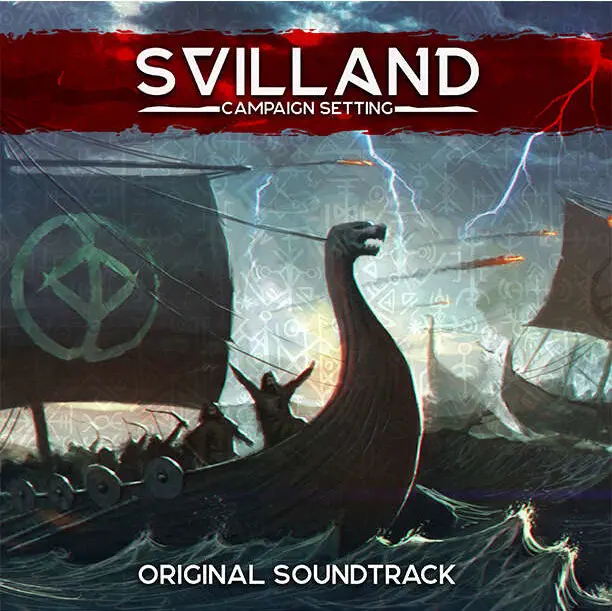
The result was a ten-track soundtrack, Svilland: Music and Ambiance — composed by me and mixed by Santiago Linietsky, and one of the projects that taught me the most about writing music for a world rather than a moment.
Scoring a Mythology, Not a Scene
Film and game scores have picture or narrative to anchor them. A tabletop soundtrack has neither. The music doesn’t know what will happen — players decide that. So you aren’t scoring events; you’re scoring the feeling of being in a place. With Svilland, that place was a cold, mythic North where the gods are real, indifferent, and dangerous.
That changes the brief in a fundamental way. The music can’t peak, because there’s no climax it’s allowed to assume. It has to hold a mood long enough to live under hours of play, vary itself enough not to grate, and never pull attention away from the table. The discipline is restraint — writing music that is unmistakably Svilland without ever raising its voice.
The Trap of “Fantasy Viking”
The easiest version of this score would have been the Hollywood-Viking cliché: big low drums, shouted male choir, a horn motif you’ve heard in a hundred trailers. It would have been wrong for Svilland, because Svilland is deliberately not that. The setting trades the power-fantasy version of the Norse world for something colder, harsher, and more honest to the sagas — survival, oath, and dread.
So I went toward authenticity instead of spectacle. The tagelharpa — a bowed Nordic lyre — became central; I’d been working it into my Nordic writing and its raw, droning voice carries the grit this world needed far better than a polished orchestra would. Frame drums, low bowed strings, breathy winds, and modal melodies built the rest. The aim was a sound that feels weathered and lived-in, like it was played in a longhouse rather than recorded on a scoring stage.
Worldbuilding Through Instrument Choice
This is the part I care about most as a composer: instrumentation is worldbuilding. Before a single melody registers, the listener has already learned something about a world from the timbres carrying it. A tagelharpa drone tells you this is a hard, old, northern place. The absence of a glossy orchestra tells you not to expect heroism on tap. The modes tell you we are far from major-key comfort.
None of that is literal. No player stops to identify an instrument. But the cumulative effect is that the world has a consistent sonic signature — and consistency is what makes a fictional place feel real rather than assembled. Every track had to belong to the same North.
What Svilland Taught Me
Svilland sharpened a principle I now bring to every worldbuilding commission: the best music for an immersive world is often the music that refuses to show off. Its job is to make the table forget it’s listening to anything — to make the cold feel cold and the myth feel close, and then get out of the way so the players’ own story can happen on top of it.
It also confirmed that authenticity beats spectacle when a setting has a strong point of view. Dream Realm Storytellers knew exactly what their world was. My job was to listen to that, resist the obvious choices, and find the instruments that already lived there.
You can hear the full soundtrack on the Svilland album page.
For more on this approach, the musical worldbuilding hub collects other projects where music and world are built together.
If this kind of compositional thinking interests you — writing music shaped by a world’s internal logic, not just its surface aesthetic — it’s something I work on directly in private mentoring. It starts with a short call to see if we’re a fit.